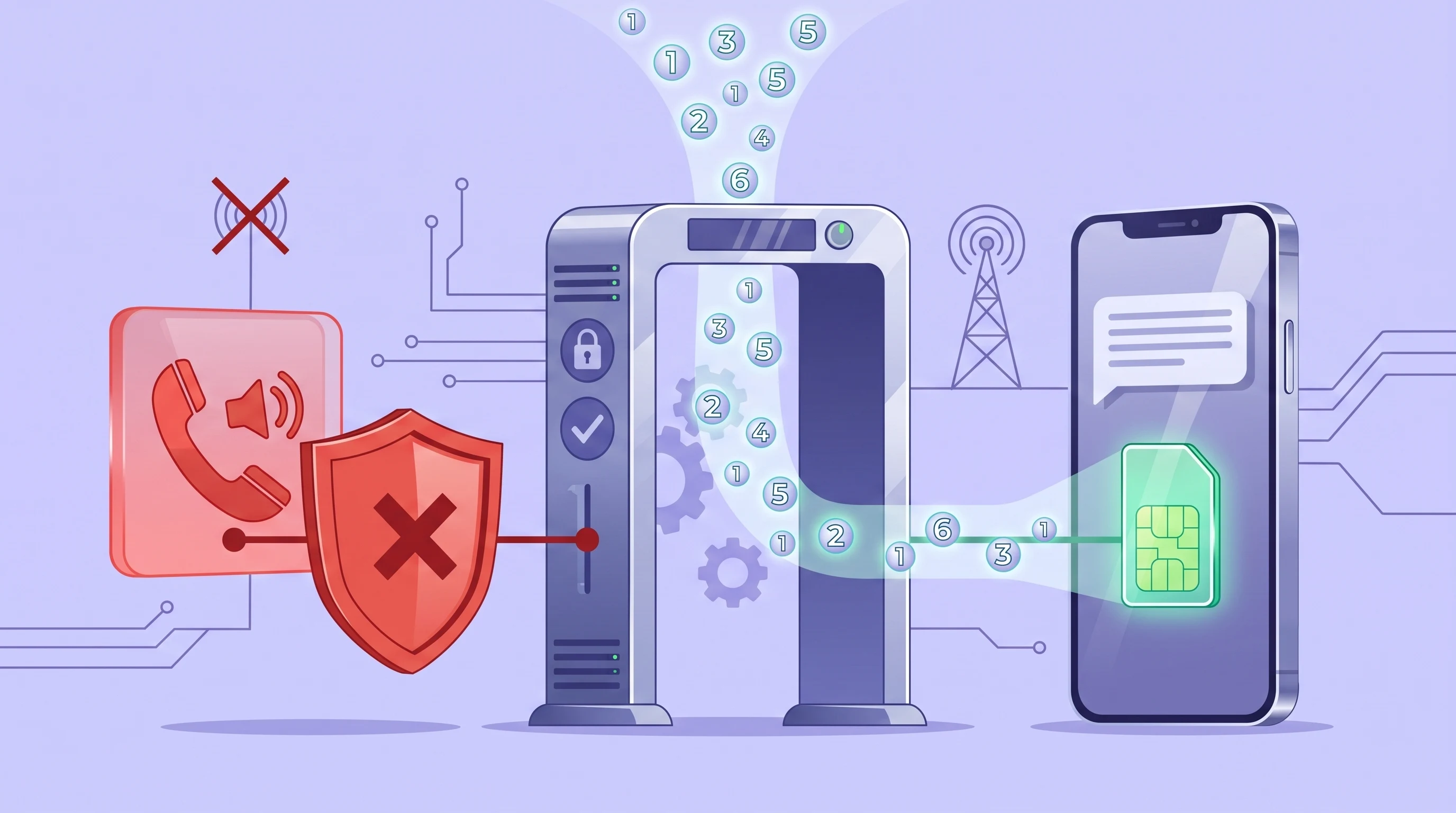
If your VoIP number is blocked, the app checked your line type during signup, saw an internet-based number, and refused it because those numbers are easy to create in bulk and hard to trace. The fix is to verify with a real, carrier-backed non-VoIP number that passes the same lookup the app just used to reject you.
That single check happens in the background, often before any code is sent. Understanding how it works tells you exactly why platforms like Google, WhatsApp, and PayPal say no, and what kind of number actually gets through.
Key Takeaways
- Apps flag VoIP numbers with a carrier lookup that reads line type before sending a code.
- Google, WhatsApp, and PayPal reject VoIP because throwaway numbers enable large-scale abuse.
- One 2026 US benchmark recorded a 0 percent SMS delivery rate for VoIP and landline numbers.
- A real non-VoIP number carries a genuine carrier record, so it passes lookups that block VoIP.
- When choosing a verification number, confirm it registers as a mobile line and comes from a real carrier, not a softphone service.
How Do Apps Detect and Flag VoIP Numbers?
Apps detect VoIP numbers by running a carrier lookup, an automated query that returns the line type, carrier name, and country for any phone number. Services such as the Twilio Lookup API can tag a number as mobile, landline, or VoIP in a fraction of a second. If the result reads VoIP, many signup flows stop right there.
The lookup pulls from telecom databases that map number ranges to their owners. A block of numbers registered to an internet calling provider gets classified as VoIP. A block assigned to a mobile network operator gets classified as mobile.
Fraud teams weight VoIP heavily as a risk signal. VoIP numbers can be created by the thousands for pennies each, which makes them a favorite tool for fake account farms, spam, and bonus abuse. When a platform sees an internet number attached to a fresh account, it often assumes the worst and blocks first.
Because the check runs before the SMS goes out, you rarely see an error that says "VoIP." You see a vague "this number cannot be used" message, or the code never comes at all.
Why Do Google, WhatsApp, and PayPal Reject VoIP?
Google, WhatsApp, and PayPal reject VoIP because these numbers make fraud cheap and accountability nearly impossible. Account takeover through phone-based attacks is a real and growing problem: US victims reported $25,983,946 in SIM swap losses across 982 complaints to the FBI in 2024. Platforms respond by tightening who can register a number at all.
Each company has its own reason to be strict:
- Google: Ties a phone number to identity recovery and to limits on how many accounts one person can open, so a disposable VoIP line undermines both.
- PayPal: Handles money, and a number it cannot trace to a real subscriber is a liability during disputes and chargebacks.
- WhatsApp: Fights spam and bulk automation, so it treats bulk-registerable VoIP lines as a threat to the network.
The enforcement style differs. Google and PayPal frequently refuse VoIP during signup. WhatsApp may accept some numbers and then ban them later if behavior or line type looks off. The common thread is that a real carrier number ties the account to a person a network can identify, and a VoIP number usually does not.
For the reader, this means a number that works fine for calls can still fail verification. The app is not judging call quality. It is judging traceability.
What Is the Technical Difference Between VoIP and Real SIM Numbers?
The core difference is where the number lives: a real SIM number is anchored to a mobile carrier's network, while a VoIP number lives on internet servers with no SIM behind it. That distinction is exactly what carrier lookups are built to expose.
A genuine mobile number is tied to a SIM card and registered in carrier systems, including the Home Location Register, or HLR, that tracks where a subscriber is on the network. When a verification service queries that number, it finds a real mobile network operator and a valid subscriber record. VoIP numbers have no SIM and no HLR entry of that kind. They route calls and messages over the public internet instead.
This is more than a technicality. The HLR and carrier records are the evidence an app uses to decide the number is legitimate. Without them, the number looks disconnected from any physical network, which reads as risk.
Delivery reflects the same gap. A 2026 US benchmark of SMS one-time password delivery reported 96 to 99.5 percent handset delivery for Tier-1 postpaid mobile numbers, but 0 percent for VoIP and landline numbers. Even when a VoIP number slips past signup, the code that decides everything may never land.
How Do Non-VoIP Numbers Pass Carrier Lookups?
Non-VoIP numbers pass carrier lookups because they are real mobile lines with authentic carrier records, so the lookup returns "mobile" instead of "VoIP." That single classification is often the whole difference between a code arriving and a signup being blocked.
When a verification service checks a non-VoIP number, the telecom database reports a legitimate mobile network operator, a valid line type, and a subscriber presence on the network. Nothing about the result trips the fraud filter that VoIP triggers. The number reads exactly like the phone in a typical customer's pocket, because in network terms it is one.
Delivery follows from that legitimacy. Real carrier numbers sit on the same infrastructure that moves ordinary text messages, so one-time passwords reach the handset at high rates. There is no internet gateway in the middle to drop or delay the message.
This is where a service like NonVoIPZone fits for people who keep hitting VoIP walls. It provides access to real non-VoIP mobile numbers meant for receiving SMS codes on platforms that block VoIP, so the number you use for verification is the kind carrier lookups approve. The point is not a trick to fool the check. It is using a number that genuinely passes it.
How Do You Choose a Reliable Verification Number?
Choose a verification number that registers as a real mobile line from a genuine carrier, because that is what determines whether your code arrives. The strongest signal of reliability is simple: run the number through the same test an app would—a carrier lookup—and confirm it returns "mobile" rather than "VoIP" or "landline."
Use these checks before you trust a number for important accounts:
- Line type: Confirm the number is classified as mobile, not VoIP. This is the single factor most apps weigh first.
- Real carrier: Prefer numbers tied to a recognized mobile network operator, not a softphone or internet calling app.
- Exclusive use: Avoid heavily shared public numbers. If thousands of strangers received codes on it, the platform may already distrust or block it.
- Country match: Pick a number in a country the target app supports, since some services restrict certain regions.
- Delivery track record: Favor a source that reliably delivers OTPs, given that some line types deliver texts at rates near zero.
A number that clears those checks behaves like a normal subscriber line, which is precisely what Google, WhatsApp, and PayPal want to see. When the lookup comes back clean, the code goes out, and you finish signup on the first attempt instead of hunting for another number.
If you have been stuck behind repeated VoIP rejections, the concrete next step is to test your current number's line type, and if it reads VoIP, switch to a real non-VoIP mobile number for that specific app before you try to register again. Match the number to the platform first, verify once, and you avoid the blocked-number loop entirely.
Frequently Asked Questions
Why is my VoIP number blocked for SMS verification?
The app ran a carrier lookup, saw that your number is a VoIP line, and rejected it before sending a code. Many platforms treat VoIP as high risk because these numbers are cheap to create in bulk and hard to trace during fraud.
Can I still receive a verification code on a VoIP number?
Sometimes, but it is unreliable. A 2026 US benchmark measured a 0 percent SMS delivery rate for VoIP and landline numbers, so many one-time passwords simply never arrive even when registration is allowed.
How is a non-VoIP number different from a VoIP number?
A non-VoIP number is tied to a real mobile carrier and has an authentic network record. A VoIP number lives on internet infrastructure and lacks the carrier data that verification systems check, which is why lookups treat the two differently.
Do Google, WhatsApp, and PayPal all block VoIP the same way?
The intent is similar but the strictness varies. Google and PayPal often reject VoIP outright during signup, while WhatsApp may accept some numbers yet flag or ban them later if the line type or usage pattern looks suspicious.
What should I look for in a reliable verification number?
Confirm it registers as a mobile line, comes from a genuine carrier, and is not shared with thousands of other users. A real non-VoIP number that passes carrier lookups gives you the best chance of receiving OTP codes on the first try.